
Rainwater Harvesting Cost in Nagpur and Maharashtra
There’s no single number that answers this honestly, because cost depends on what you’re actually installing and why. What we can do is walk through what actually drives the price, so you can tell whether a quote you’ve received makes sense.
What actually determines the cost
- Roof and paved catchment area — more collection area means a larger filtration and storage capacity is needed
- Structure type — an open well, bore well recharge, underground storage tank, and percolation pit all have different excavation, material, and labour costs
- Soil and site conditions — hard rock or high water table sites can need deeper or differently designed structures
- Filtration system quality — this is where most of the long-term cost difference actually shows up
Why the filter you choose matters more than the upfront price
A cheap soak pit filled with stones looks like a bargain on day one. In practice, an unfiltered soak pit typically has a working life of around 3 years before it silts up and needs to be dug out and rebuilt — and that rebuild cost repeats every few years. A properly engineered filter system, like the Rainy filter units we install, is designed for a service life of around 20 years with periodic cleaning rather than reconstruction.
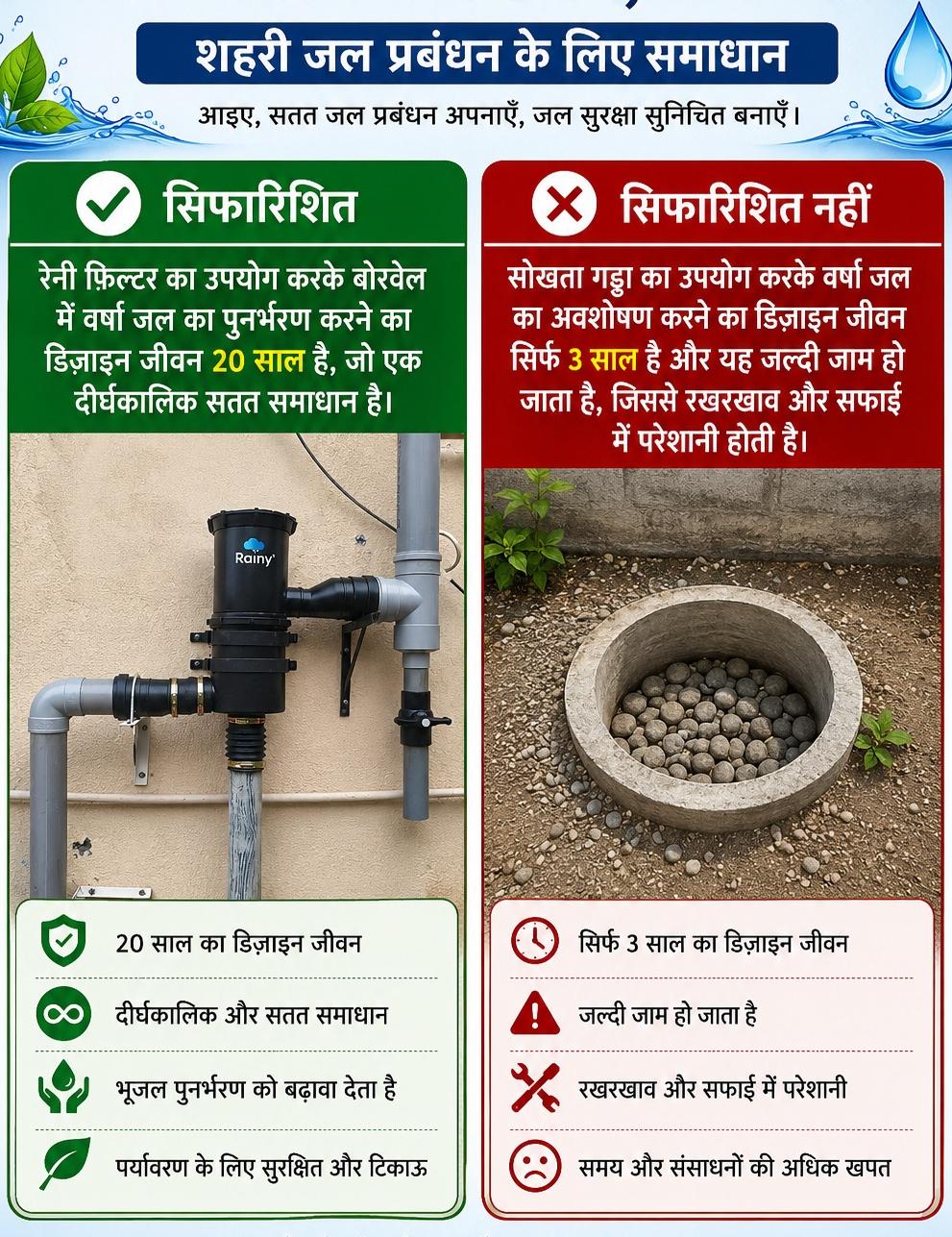
Run the maths over 20 years and a design built to last usually costs less overall than repeatedly rebuilding a cheaper structure — on top of which, a silted-up, non-functional soak pit doesn’t actually satisfy the Nagpur Municipal Corporation’s rainwater harvesting requirement even if it was compliant on paper when installed.
Getting an accurate quote
Because catchment area, soil type, and structure choice all vary by property, an accurate cost estimate needs a site visit rather than a phone-quoted number. Get in touch through our rainwater harvesting page and we’ll assess your site and give you a real, itemised quote rather than a guess.
Related Reading
- Is Rainwater Harvesting Mandatory in Nagpur?
- CGWA NOC and Rainwater Harvesting Connection
- Rainwater Harvesting Maintenance Guide
- Recharge Pit vs Storage Tank Nagpur
- Rainwater Harvesting for Housing Societies in Nagpur
- Borewell Recharge in Nagpur
- Rainwater Harvesting 101: The Complete Guide
Frequently Asked Questions
Is a cheaper soak pit a false economy?
Often, yes. A basic soak pit’s roughly 3-year working life means repeated rebuilding costs, while a properly filtered system designed for around 20 years avoids that recurring expense.
Does a bigger roof area always mean higher cost?
Generally yes, since the filtration and storage capacity needs to scale with the volume of water being collected, but the relationship isn’t perfectly linear — site assessment gives the real number.
Can I get a phone quote without a site visit?
Not an accurate one. Soil type, existing plumbing, and available space all affect the design, so a real quote needs a site assessment.