
Rainwater Harvesting: The Complete Guide
Search “rainwater harvesting” and you’ll find plenty of generic explainers. This one is built around India specifically – the regulations that actually apply here, the groundwater numbers that actually matter here, and the four structure types Nagpur’s own municipal bylaw recognises. If you want the short version for Nagpur, our rainwater harvesting Nagpur page covers that directly; this guide is the deeper reference underneath it.
What Is Rainwater Harvesting?
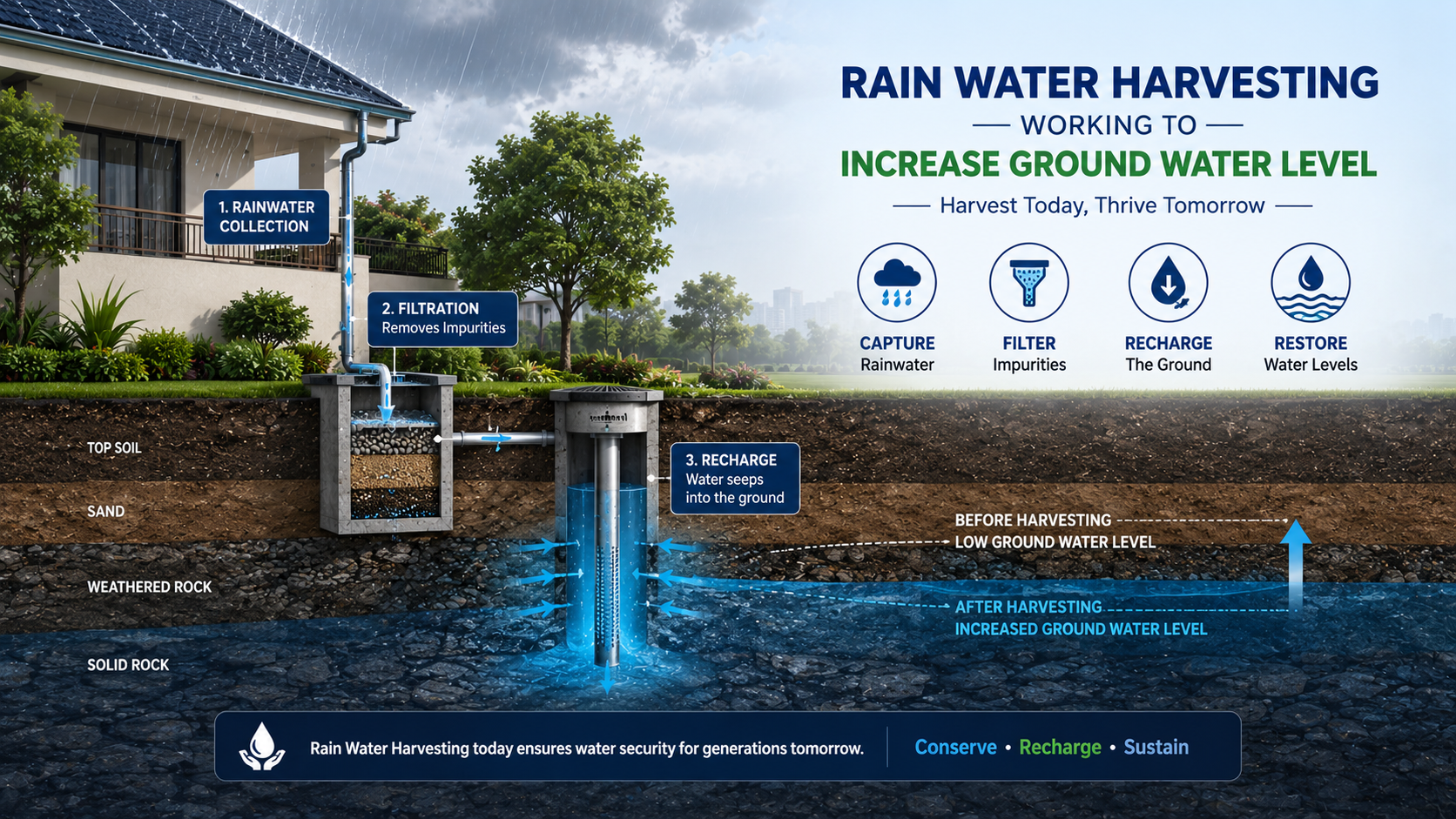
Rainwater harvesting is the practice of collecting rain where it falls – usually off a roof – and either storing it for later use or directing it back into the ground to recharge the water table beneath a property. It isn’t one fixed technique. Depending on the site, it can mean a simple tank that catches monsoon runoff for washing and gardening, or a filtered recharge structure whose only job is putting water back into an aquifer that a borewell is drawing from.
What ties every version of it together is the same basic sequence: rain lands on a catchment surface (almost always a roof, sometimes a paved courtyard), it’s carried through gutters and downpipes to a filter that removes leaves and debris, and from there it either goes into storage or into a structure designed to let it soak back into the ground.
Where India's Groundwater Actually Stands
In 2026, the Ministry of Jal Shakti’s Dynamic Groundwater Resources Assessment 2025 put India’s national stage of groundwater extraction at 60.63% – meaning the country as a whole draws just over three-fifths of what its aquifers recharge annually. Of the 6,762 assessment units surveyed nationally, 10.8% are classified Over-Exploited and a further 2.97% Critical, meaning extraction there already exceeds what natural recharge can sustain.
Maharashtra’s own numbers are considerably healthier than the national picture – 85.24% of the state’s 359 taluks are classified Safe – but they aren’t uniform: 7 taluks are Over-Exploited and 5 are Critical. That’s the real reason rainwater harvesting isn’t optional guidance in Nagpur specifically: it’s a direct response to which classification a given area falls into, not a blanket rule applied for its own sake.
It's Not Just Nagpur
Nagpur’s own rainwater harvesting bylaw – mandatory since 2005 for layouts, open spaces, and new constructions of 300 square metres or more – isn’t an isolated local rule. It’s part of a pattern that goes back over two decades across Indian cities.
Tamil Nadu was first: the Tamil Nadu Municipal Laws Ordinance of 2003 made rainwater harvesting mandatory for every building in the state, with water and sewer connections withheld from anything built after the deadline that didn’t comply. Mumbai followed the same year with its own municipal rule – new buildings within the MCGM area were denied full water connections unless they harvested rainwater, initially for buildings over 1,000 square metres, later extended to smaller plots. Karnataka’s largest cities, including Bengaluru, brought in mandates of their own for major urban centres, backed by a property tax rebate as an incentive rather than a penalty alone. Rajasthan requires it for urban properties over 500 square metres and for all public buildings regardless of size.
The pattern across all of these, Nagpur included: the threshold and the enforcement mechanism differ by city, but the underlying logic is the same – groundwater stress reached a point where voluntary adoption wasn’t enough. For what Nagpur’s own rule specifically requires, see our guide on whether rainwater harvesting is mandatory in Nagpur.
Benefits of Rainwater Harvesting
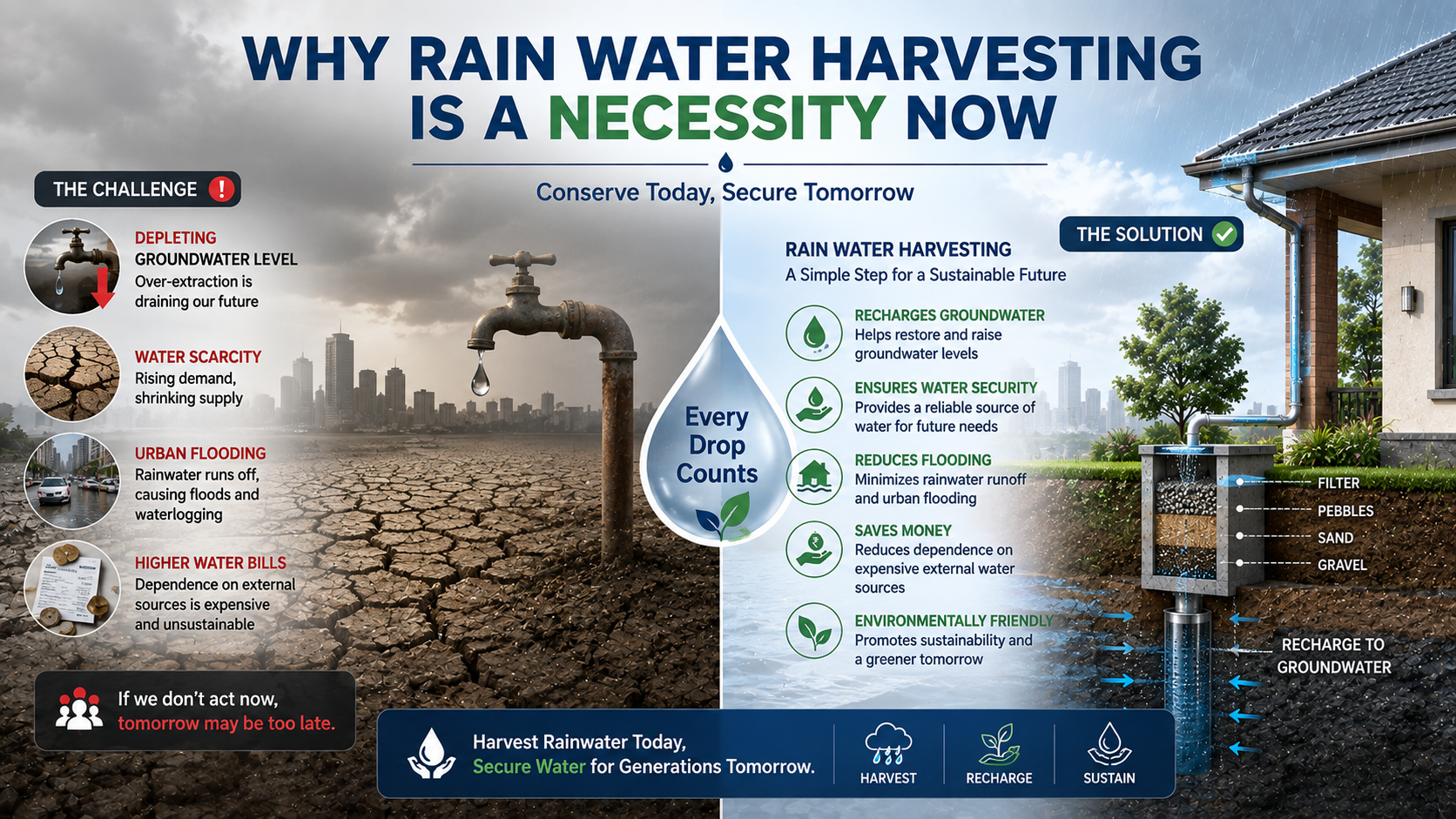
Lower dependency on tankers and borewells
Less reliance on trucked-in water or a stressed borewell during peak summer months.
Groundwater recharge
Supports long-term aquifer health in areas where extraction already outpaces natural recharge.
Reduced flooding and waterlogging
Captured runoff means less water pooling around a property during heavy monsoon spells.
Regulatory compliance
Meets municipal and CGWA requirements wherever a mandate applies, rather than risking a recurring fine.
Lower water costs
Reduces dependence on municipal supply for non-potable use - gardening, washing, flushing.
Resilience during dry spells
Stored or recharged water remains available when municipal supply is under stress.
How Much Rain Can You Actually Collect?
The standard way to estimate this is one formula: catchment area (in square metres) multiplied by rainfall (in millimetres) multiplied by a runoff coefficient, divided by 1,000 to get the result in litres. The runoff coefficient accounts for water lost to evaporation, absorption, and overflow before it reaches your storage or recharge structure – a typical concrete or tiled roof runs somewhere around 0.8 to 0.85, meaning 80-85% of what falls on it is actually collectible.
Rather than working through that formula by hand, use the calculator below – enter your roof area and region and it will estimate what a typical monsoon season could realistically deliver.
Maharashtra Rainwater Harvesting Calculator
Estimate your site's annual aquifer recharge potential
Calculation baseline is formulated on typical hydrogeological runoff coefficients approved by CGWB: Volume = Area × Rainfall Depth × Runoff Coefficient.
Estimated Annual Resource Recovery
Realistic Rainwater Recovered
Equates to 1,53,290 Litres of raw precipitation, with standard runoff allowance.
Methods of Rainwater Harvesting
Nagpur’s own byelaw recognises four structure types, and the right one for a given site depends on soil, space, and what the collected water is actually for – storage and reuse, or putting it back into the ground.
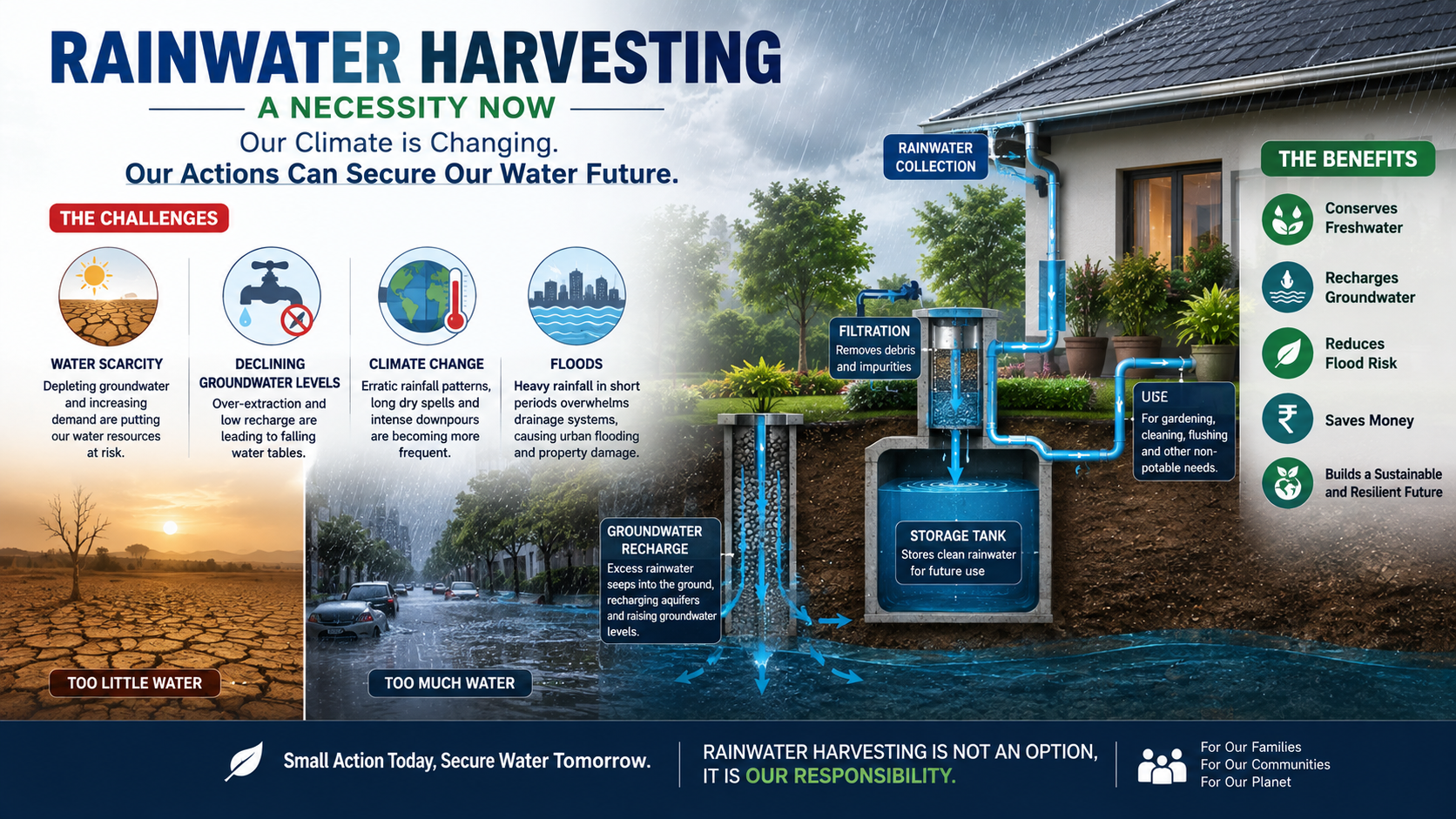
Open well – the traditional structure, at least 1 metre in diameter and 6 metres deep under Nagpur’s own bylaw. Works well where the water table is accessible and space allows for it.
Borewell recharge – routes filtered water directly down an existing or purpose-drilled bore to recharge the aquifer at depth, rather than letting it percolate through surrounding soil. Needs a higher filtration standard than a surface structure. See our borewell recharge guide for how this works and when it’s the right choice.
Underground storage tank – captures water for direct non-potable reuse: flushing, gardening, washing, topping up during dry spells. Needs more plumbing design thought than a recharge structure and doesn’t recharge groundwater on its own.
Percolation pit – lets filtered rainwater soak into the surrounding soil, replenishing the local water table rather than storing it for reuse. Often the right choice when supporting a borewell’s long-term yield is the priority.
Many properties end up using more than one of these together. See our guide on recharge pits versus storage tanks for how to decide between the reuse-focused and recharge-focused approaches.
Key Components of a Rainwater Harvesting System
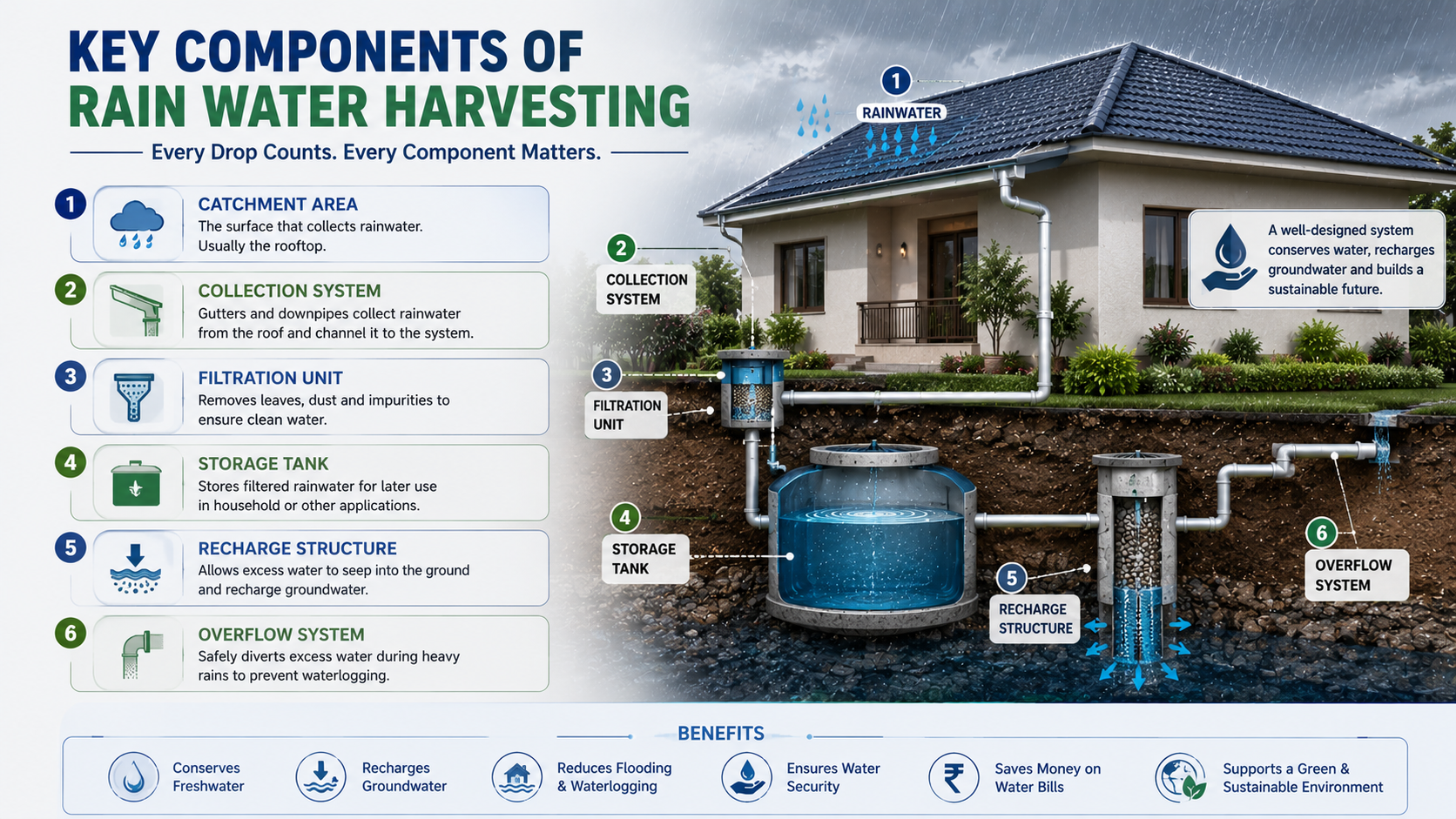
- Catchment surface – almost always the roof; occasionally a paved courtyard or terrace.
- Gutters and downpipes – carry collected water from the catchment surface down to the filter and storage or recharge point.
- First-flush diverter – discards the initial, dirtiest runoff at the start of each rain event before it reaches the filter.
- Filter – removes leaves, dust, and suspended particles. This is where filter quality actually matters most: a basic mesh clogs and needs frequent cleaning, while a properly engineered filter (like the Rainy Filter systems we install) is built for a much longer service life with minimal upkeep.
- Storage tank or recharge structure – where the filtered water actually ends up, depending on which of the four structure types the design uses.
- Overflow arrangement – directs excess water safely away once storage or recharge capacity is reached, so the system doesn’t back up during heavy rainfall.
Is Rainwater Harvesting Mandatory Where You Live?
Whether rainwater harvesting is legally required for your property depends on where you are and how large your plot or building is. In Nagpur specifically, it’s been mandatory since 2005 for layouts, open spaces, and new constructions of 300 square metres or more, with an annual fine for non-compliance. Read our full breakdown in Is Rainwater Harvesting Mandatory in Nagpur? – it also covers what happens if your property extracts groundwater through a borewell, which brings CGWA compliance into the picture alongside the municipal requirement.
Keeping It Working
A rainwater harvesting system that’s installed and then ignored stops doing its job within a few monsoons – filters clog, first-flush diverters stop diverting, and storage or recharge structures silt up. Our maintenance guide covers what actually needs a pre-monsoon check, and how much less upkeep a properly filtered system needs compared to a basic soak pit.
Frequently Asked Questions
Ready to Assess Your Property?
Every property is different – catchment area, soil, an existing borewell if you have one, and which of the four structure types actually fits. Get an actual site assessment rather than guessing from a generic guide, including this one.