
Rainwater Harvesting for Housing Societies in Nagpur: What RWAs Need to Know
Nagpur Municipal Corporation’s rainwater harvesting byelaw doesn’t single out individual homes — its own wording covers layouts, open spaces, and amenity spaces of housing societies, alongside new constructions of 300 square metres or more. If your society’s layout crosses that threshold, the obligation sits with the society, not with any one flat owner.
Why the obligation sits with the society, not individual owners
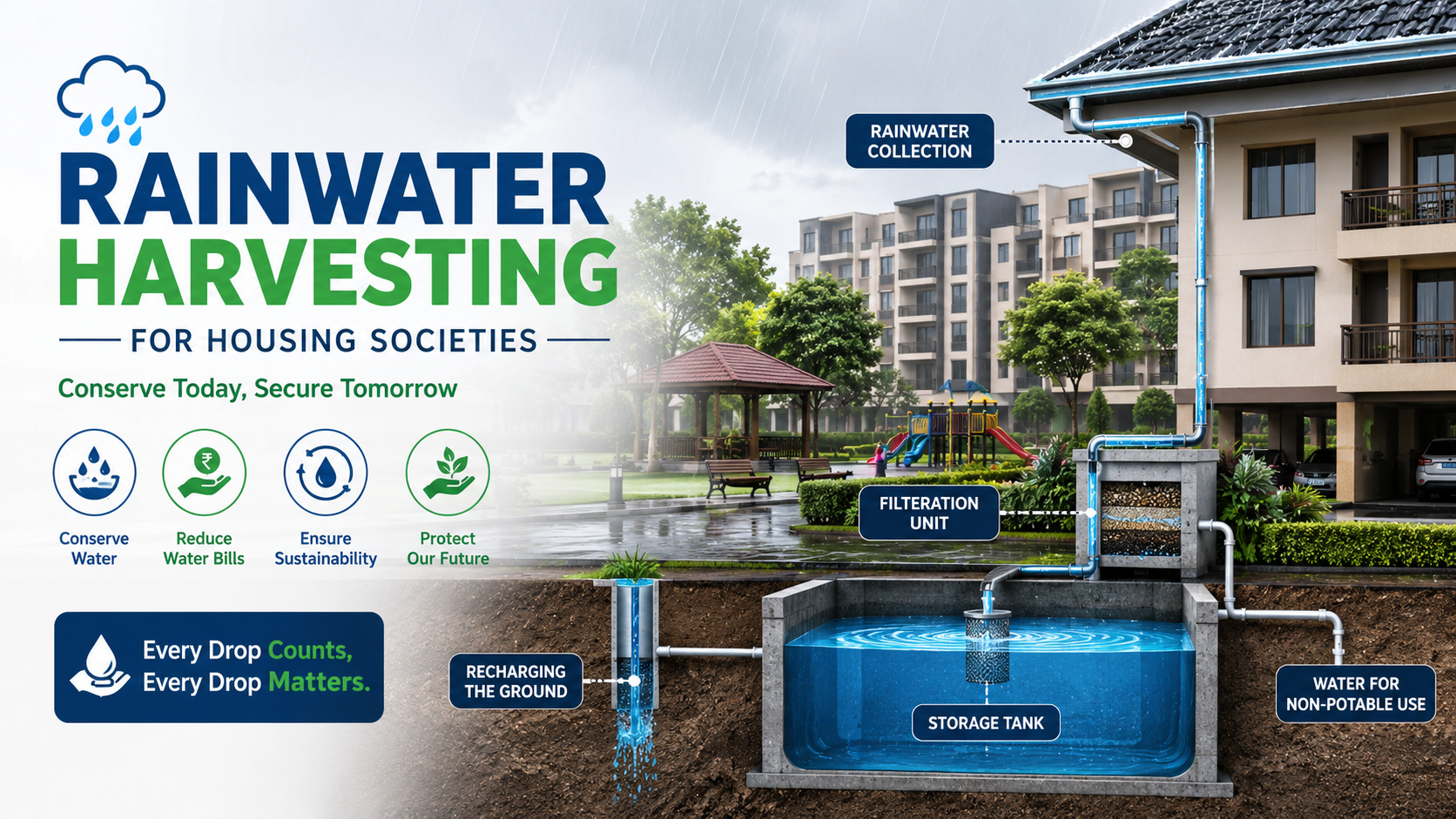
Layouts, common open spaces, and amenity areas belong to the society as a body, which is why compliance and any resulting fine are tracked against the society’s registration with Nagpur Municipal Corporation rather than against a single flat. In a multi-building layout, that generally means one rainwater harvesting structure — or a small number of them — sized to the combined catchment area of the whole layout, not one per building.
The fine works the same way it does for any other property
Non-compliance is charged at up to ₹1,000 per year for every 100 square metres of built-up area, and it recurs annually for as long as the structure is missing or non-functional. For a layout with several blocks, that built-up area adds up fast across the whole society, which is usually what turns this from a minor line item into something a managing committee needs to actually budget for.
Maintenance is a standing responsibility, not a one-time approval
The structure has to stay in good repair for as long as the buildings stand — that responsibility doesn’t end once the system passes its initial inspection. For a society, this usually means someone — a maintenance staff member, facility manager, or a vendor on contract — needs to own a pre-monsoon check as a standing item, the same way lift or fire safety checks are handled. A soak pit without proper filtration typically needs full reconstruction within about 3 years, which for a society usually means a special collection or resolution at an AGM. A properly filtered system, like the Rainy Filter units we install, is built for a service life of around 20 years with periodic cleaning instead — a much easier thing for a managing committee to plan for.
Designing for a multi-building layout
A housing society usually has considerably more combined roof and paved area than a single house, spread across several blocks — so the design needs to work from the layout’s total catchment, not just one building’s roof. Many societies in Nagpur also run their own borewell for supplementary water, and if yours does, the same rainwater harvesting system can often be designed to double as a recharge measure that supports your CGWA compliance as well as the municipal requirement — one system, two obligations, if it’s planned that way from the start.
Taking it to your managing committee
Getting a design and cost approved usually means presenting it at an AGM or a special general body meeting, and a verbal estimate doesn’t hold up well in that setting. It’s worth getting an actual site assessment and a written, itemised quote first — reach out through our rainwater harvesting page and we’ll assess your layout directly rather than working off assumptions.
Related Reading
- Is Rainwater Harvesting Mandatory in Nagpur?
- Rainwater Harvesting Cost in Nagpur and Maharashtra
- CGWA NOC and Rainwater Harvesting Connection
- Rainwater Harvesting Maintenance Guide
- Recharge Pit vs Storage Tank Nagpur
- Borewell Recharge in Nagpur
Frequently Asked Questions
Does every block in our society need its own rainwater harvesting structure?
Not necessarily. Depending on how your layout is registered and the site conditions, one system sized to the combined catchment area of the whole layout can often work — but that needs to be confirmed against your actual site plan, not assumed.
Who’s responsible if our society was built before the 2005 requirement came in?
The byelaw applies at the point of building permission, so older layouts aren’t automatically exempt if they fall within scope and remain non-compliant. See our guide on whether rainwater harvesting is mandatory in Nagpur for how that’s enforced.
Is this the builder’s responsibility or the society’s?
For new construction, provision has to be made before building permission is granted, which generally makes it the developer’s responsibility at that stage. Once a society is formed and running, the ongoing obligation — including maintenance — sits with the society.
How much should our society budget for this?
It scales with your layout’s total catchment area and site conditions, the same cost drivers covered in our rainwater harvesting cost guide — a site visit gives you a real number rather than a guess.