
Borewell Recharge in Nagpur: What It Is and When It’s the Right Choice
Borewell recharge is one of the four structures Nagpur Municipal Corporation’s rainwater harvesting byelaw accepts — alongside an open well, an underground storage tank, and a percolation pit. It works differently from a surface pit, and it comes with a stricter filtration requirement that’s worth understanding before you commit to it.
What borewell recharge actually does
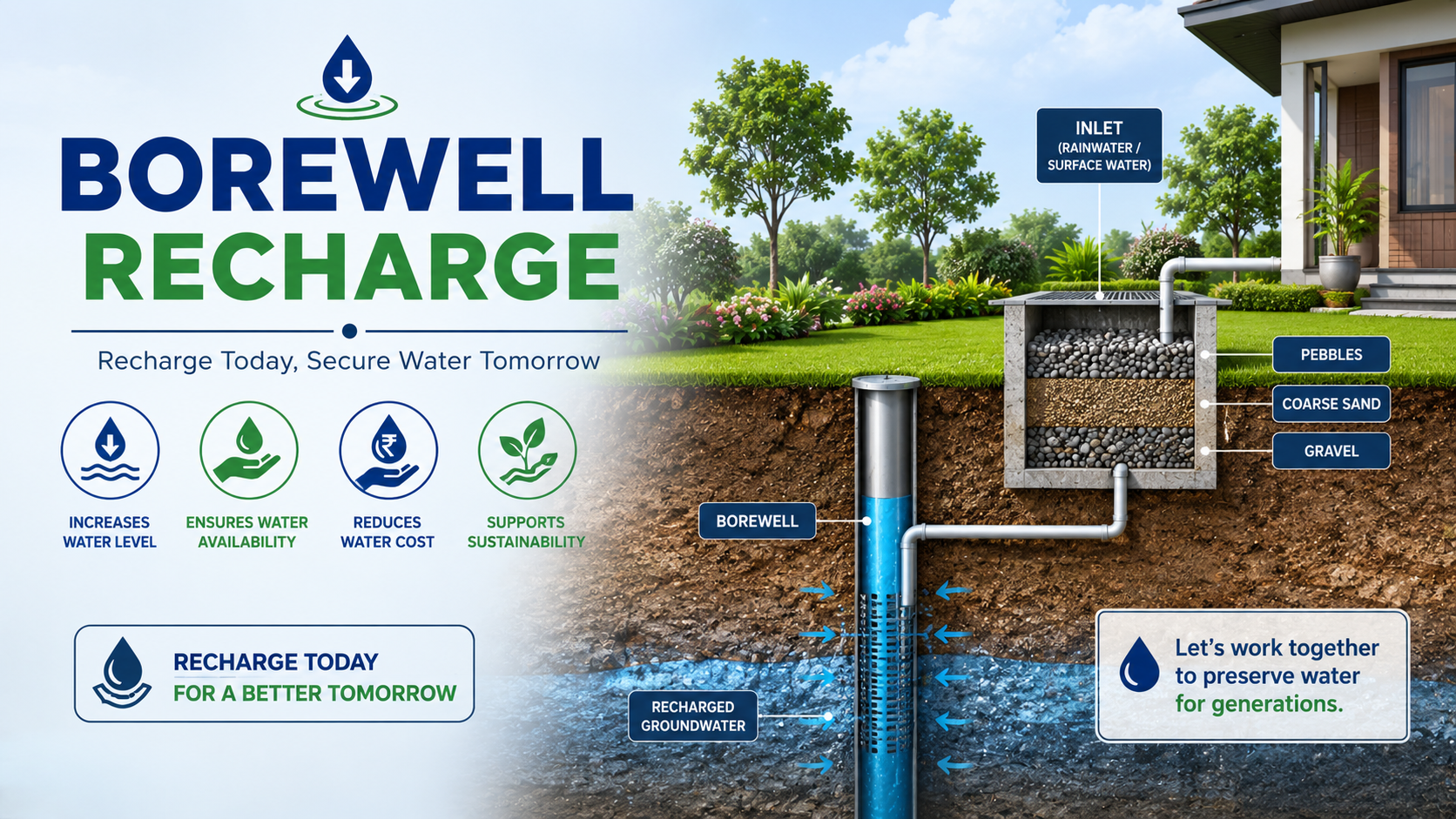
Instead of letting collected rainwater percolate through the surrounding soil the way a pit does, borewell recharge routes filtered water directly down an existing or purpose-drilled bore, feeding the aquifer at depth. It’s a more direct route back into the ground, which is exactly why it needs a higher standard of filtration ahead of it than a pit does.
Why filtration matters more here than anywhere else in the system
A percolation pit that silts up can be dug out and rebuilt — inconvenient, but fixable. A borewell that receives poorly filtered runoff doesn’t have that option: silt and debris going down the bore can clog the aquifer’s own pore spaces or foul the borewell itself, and that kind of damage is far harder and more expensive to reverse than rebuilding a pit. This is the main reason we don’t recommend routing rainwater into a borewell through anything less than a properly engineered filter — a basic mesh screen isn’t enough for this particular structure, even where it might get by on a pit.
When borewell recharge is the right call
It tends to make the most sense when the priority is directly supporting the yield of a specific borewell — your own or one nearby — when the site’s soil doesn’t percolate well enough for a surface pit to work efficiently, or when there simply isn’t the open space a pit needs. It’s also frequently the structure CGWA wants to see when recharge measures are tied to an extraction NOC, because it targets the same aquifer the extraction is drawing from, directly. See our guide on recharge pits versus storage tanks for how it compares to the other structure types.
How this fits into a CGWA NOC application
When groundwater is classified Semi-Critical, Critical, or Over-Exploited, CGWA looks at recharge measures as a genuine positive factor in evaluating an extraction NOC application. Borewell recharge is one of the more direct ways to demonstrate that, since it’s putting water back into the same source you’re drawing from rather than a general recharge elsewhere on the site. Our CGWA NOC services cover the application itself; this is the structure that often supports it.
If you’re weighing up whether borewell recharge is the right structure for your site, get in touch through our rainwater harvesting page and we’ll assess your soil, your existing borewell if you have one, and what CGWA is likely to expect for your area.
Related Reading
- Is Rainwater Harvesting Mandatory in Nagpur?
- Rainwater Harvesting Cost in Nagpur and Maharashtra
- CGWA NOC and Rainwater Harvesting Connection
- Rainwater Harvesting Maintenance Guide
- Recharge Pit vs Storage Tank Nagpur
- Rainwater Harvesting for Housing Societies in Nagpur
Frequently Asked Questions
Can an existing borewell be converted for recharge, or does it need a new one?
Often an existing bore can be used, but it needs a site check first to confirm its condition and to make sure the design properly separates recharge from any extraction happening through the same or a nearby bore.
Is borewell recharge better than a percolation pit?
Neither is universally better — it depends on your soil’s percolation rate, available space, and whether you’re specifically trying to support a particular borewell’s yield. See our recharge pit vs storage tank guide for the fuller comparison.
Does a borewell recharge system need more maintenance than a pit?
The system itself doesn’t need constant attention, but the filtration ahead of it has to be reliable, since a borewell is much harder to inspect and clean than a surface pit if something goes wrong. See our maintenance guide for what a proper filter system needs.
Does borewell recharge guarantee my CGWA NOC will be approved?
No single measure guarantees approval — CGWA evaluates the full application. Demonstrated recharge through the same aquifer you’re drawing from is a genuine positive factor, though.