A rainwater harvesting system can look different from one property to the next — a tank here, a recharge pit there, a well somewhere else — but underneath that variation, every functioning system is built on the same handful of principles. Understanding these matters more than memorising a parts list, because they explain why a system is designed a certain way, which is what actually lets you judge whether a given design is a good one.
1. Capture Close to the Source
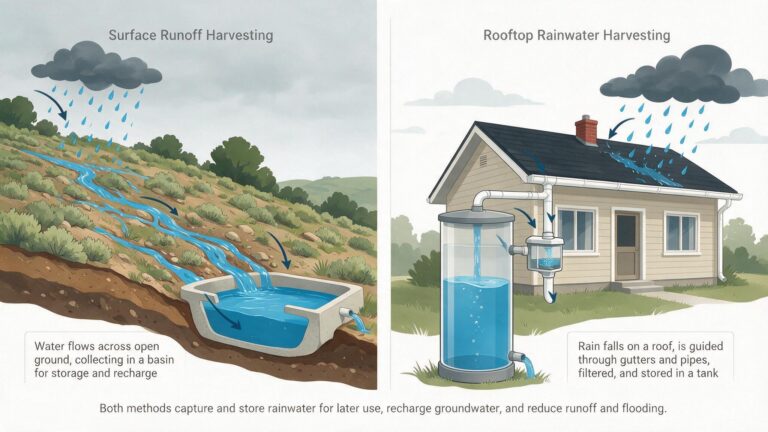
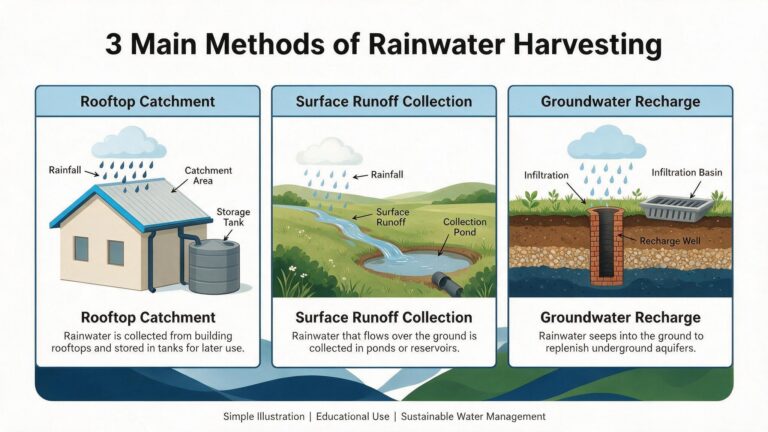
The most water-efficient point to collect rain is exactly where it falls — on the roof or ground surface it lands on — rather than after it has already run off into a drain or joined a larger flow elsewhere. This is why rooftop harvesting is built directly at the building rather than trying to intercept water further downstream: every metre of uncontrolled runoff is water lost to evaporation, ground absorption, or drainage before it can be captured.
2. Minimise Loss Before Storage
Every stage between the roof and the tank — gutters, downpipes, filters — is a place water can be lost to leaks, overflow, or blockage. Good design accounts for this at every joint: gutters sized to handle heavy rainfall without overflowing, downpipes with enough capacity for the calculated catchment area, and filters that don’t restrict flow so much that water backs up and spills before it can pass through.
3. Filter Before You Store or Recharge
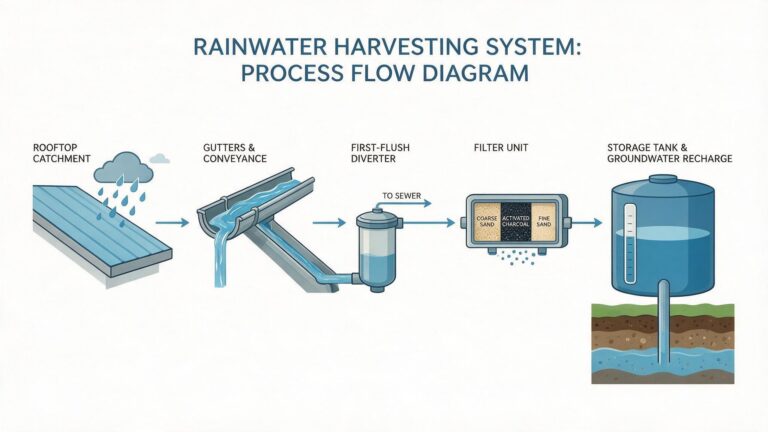
Untreated runoff carries dust, leaves, bird droppings, and whatever else has settled on a roof or ground surface since the last rain. This principle is why a first-flush diverter and filter sit before storage or recharge in every properly designed system, not after — water quality is controlled at the point of entry, because it’s far harder to correct once contaminated water has already reached a tank or been sent into the ground.
4. Match the Structure to the Site
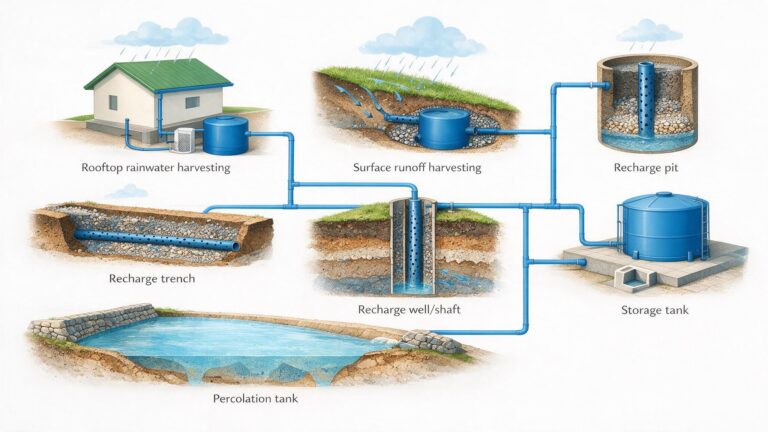
There’s no single correct rainwater harvesting design — the right structure depends on catchment area, available open space, and soil permeability. Sandy, fast-draining soil favours a recharge pit; denser soil or limited open space might call for a recharge well instead. This is the principle behind the site assessment step in the rainwater harvesting process, and it’s why a design that works well on one plot can genuinely be the wrong choice on the next one over.
5. Recharge What You Don’t Use
A storage tank should never be the end of the line for excess water. Once a tank is full, the overflow needs somewhere to go — ideally a recharge structure that sends it back into the ground, rather than a stormwater drain where it contributes nothing to the local water table. This principle is what turns a purely domestic water-saving system into one that also supports the wider groundwater situation around it.
How These Principles Show Up in a Real System
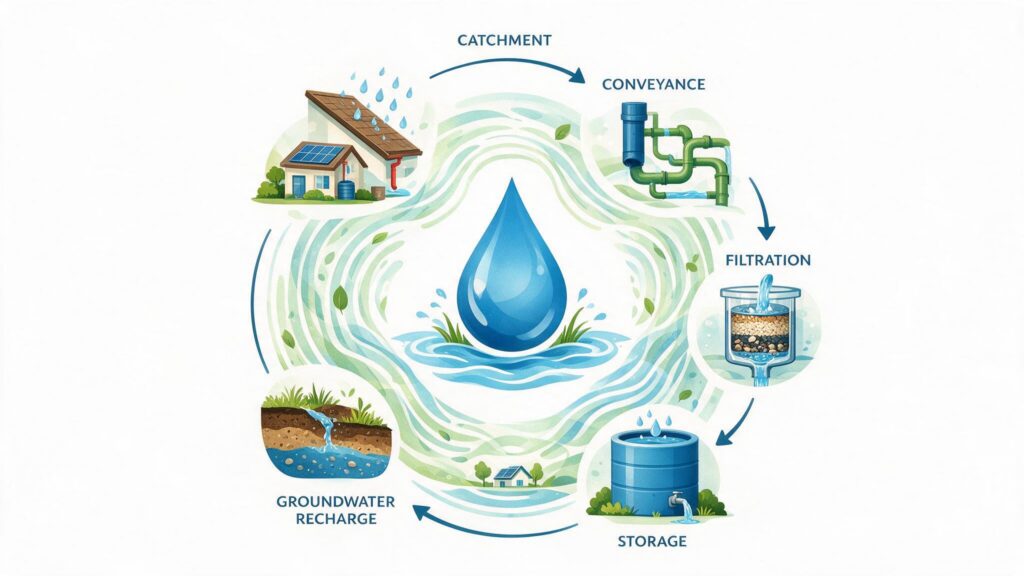
Put together, these five principles are the reasoning behind the physical structure of a rainwater harvesting system — catchment, conveyance, first-flush, filter, then storage and recharge, in that specific order, for specific reasons. If a system skips a step, it’s usually one of these principles being compromised, and it’s almost always the reason a system underperforms even when it looks complete on the surface.
Frequently Asked Questions
Which principle is most commonly ignored in cheap installations?
Filtering before storage. It’s the step that doesn’t affect whether water reaches the tank, so it’s the one most likely to be skipped or downgraded under cost pressure — and it’s also the one whose absence causes the most trouble later, through contaminated storage or clogged recharge structures.
Do these principles apply to both residential and commercial systems?
Yes. Scale changes — a commercial or industrial system handles far more catchment area and volume — but the same five principles govern the design either way.
Is groundwater recharge always necessary, even in a storage-focused system?
Not strictly necessary for the system to function, but it’s strongly recommended and often legally required above a certain plot size, since it’s what prevents excess water from being wasted once storage capacity is reached.