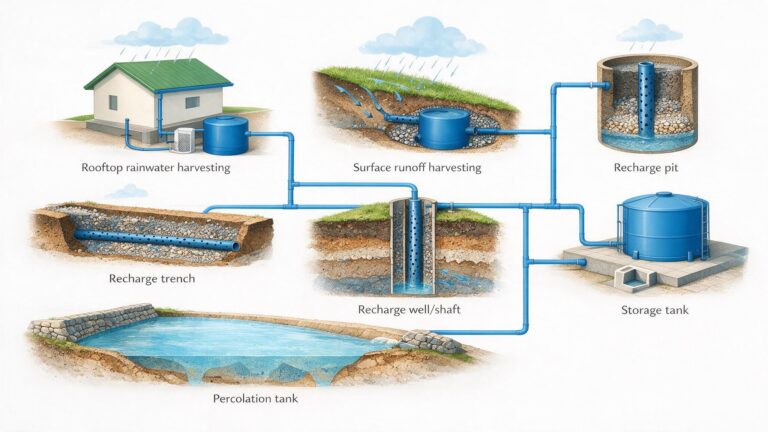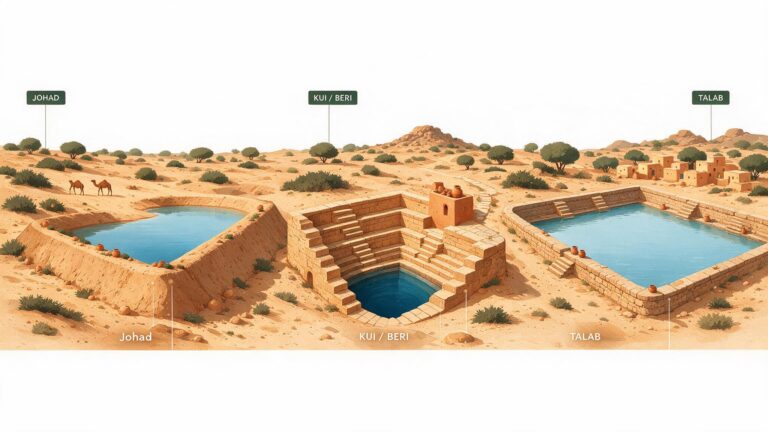
“Structure” in rainwater harvesting can mean two different things, and it’s worth being clear about which one you’re asking about. It can mean the physical components that make up a system — the gutters, filters, and tanks — or it can mean a specific recharge structure like a pit or a well. This guide covers the first meaning: the complete anatomy of a working rainwater harvesting system, component by component, in the order water actually passes through them.
1. Catchment
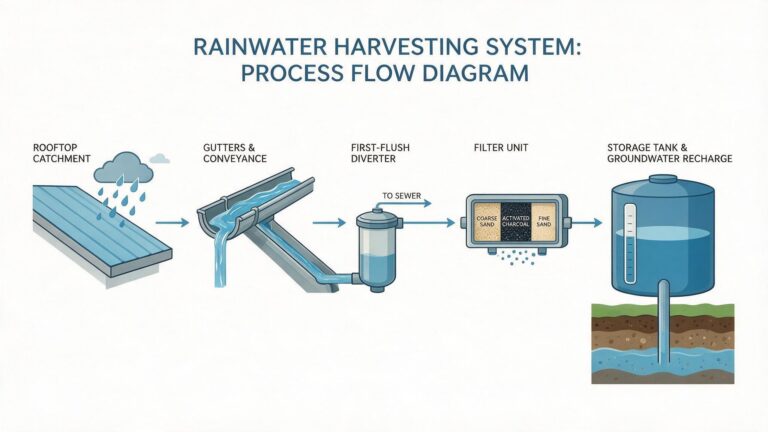
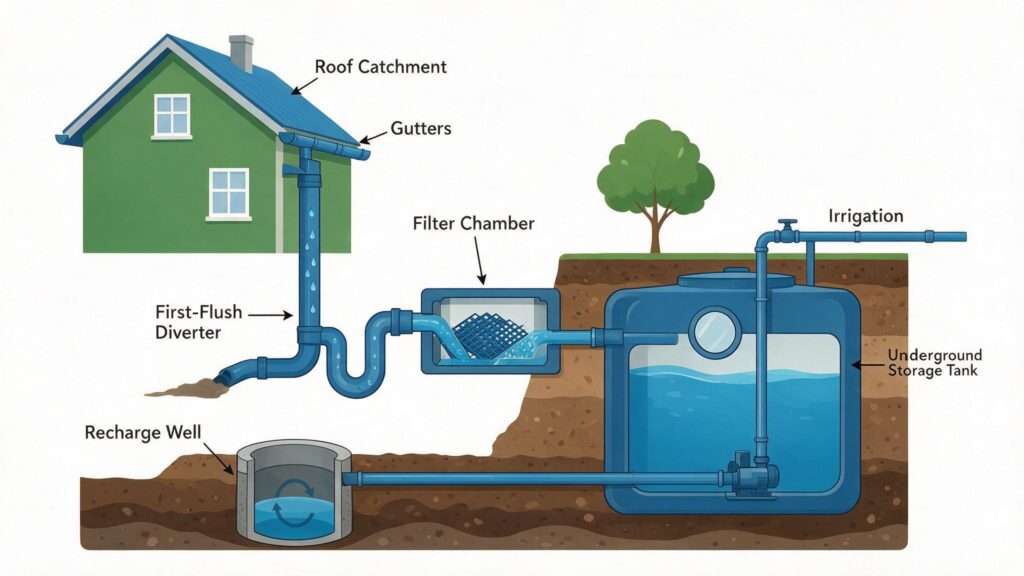
The catchment is the surface that first receives rainfall — almost always a roof for residential systems, though it can be a paved courtyard or open ground for surface runoff harvesting. Roof material matters here: RCC, tiled, and metal sheet roofs all shed water differently, and a system’s design accounts for the specific catchment surface it’s built around.
2. Conveyance
Gutters run along the roof edge to collect water as it sheds off, feeding into a downpipe that carries it down to ground level. Gutters can be semi-circular or rectangular, made from PVC, GI sheet, or other durable material, and need to be sized to the catchment area — an undersized gutter is one of the most common points of failure in an otherwise well-designed system.
3. First-Flush Diverter
A first-flush diverter is a simple valve mechanism that discards the initial flow of any rainfall event before it enters the rest of the system. That first flow carries the highest concentration of dust, leaf litter, and bird droppings that have settled on the roof since the last rain, so removing it before filtration significantly reduces the load on everything downstream.
4. Filter
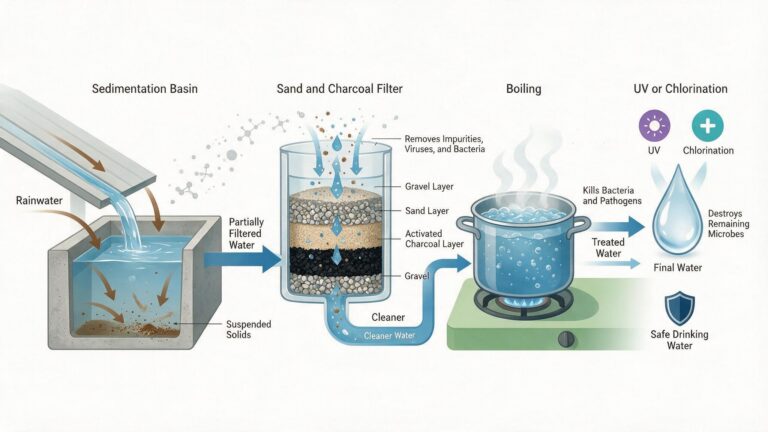
Filtration removes suspended particles from water that has already passed the first-flush stage. Several filter designs are used in Indian systems: layered sand and gravel filters, charcoal filters housed in a drum or earthen pot, and proprietary self-cleaning mesh filters that don’t need manual cleaning after every rainfall. The right filter choice depends on catchment area, water quality needs, and how much manual maintenance the owner is realistically going to keep up with.
5. Storage Structure
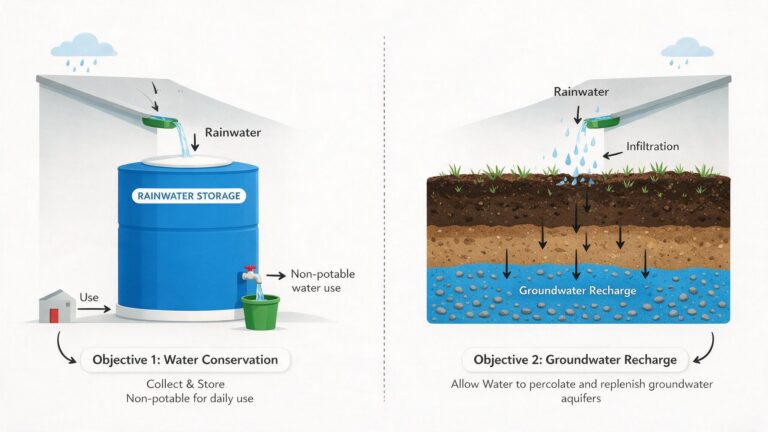
Where the design includes storage for reuse, water is held in a tank — above ground, partially underground, or fully underground — built from RCC, ferrocement, masonry, or durable plastic. Tank sizing is calculated from expected harvesting potential, not guessed, since an undersized tank overflows too often to be useful and an oversized one is unnecessary cost.
6. Recharge Structure
Where the design includes groundwater recharge, filtered water is directed into a recharge pit, trench, or well, sized and sited according to the site’s soil permeability and depth to groundwater. This is covered in detail in our guide to the seven types of rainwater harvesting, since the recharge structure is where most of the design variation between properties actually shows up.
7. Overflow
Every properly designed storage tank includes an overflow outlet, positioned so that once the tank reaches capacity, excess water is redirected — ideally to a recharge structure, rather than allowed to simply spill onto the ground or into a stormwater drain where it serves no further purpose.
How It All Connects
In sequence: catchment collects, conveyance transports, the first-flush diverter discards the dirtiest initial flow, the filter cleans what remains, and the water then either goes to storage for use or a recharge structure for the aquifer — with overflow ensuring nothing is wasted once storage is full. This is the same sequence covered step by step, including how each component gets sized and installed, in our guide to the rainwater harvesting process.
Going Deeper on Filtration and Storage
For more on what happens at the filtration and storage stages specifically, see our guides on how to purify rainwater and how long rainwater can be safely stored.
Frequently Asked Questions
Does every system need all seven components?
Not necessarily storage or recharge both — a system can be built purely for one or the other — but catchment, conveyance, first-flush, and filtration are present in essentially every properly built system, regardless of what happens to the water afterward.
Which component is most often built undersized?
Gutters and downpipes, since their sizing isn’t always calculated against the actual catchment area — a mistake that doesn’t show up until a heavy rainfall event causes visible overflow at the roofline.
Can an existing structure be added to later, like adding a recharge well to a storage-only system?
Yes, in most cases. A recharge structure can usually be added onto an existing storage-only setup by tapping into the overflow outlet, provided there’s suitable open space and the site’s soil and groundwater depth support it.