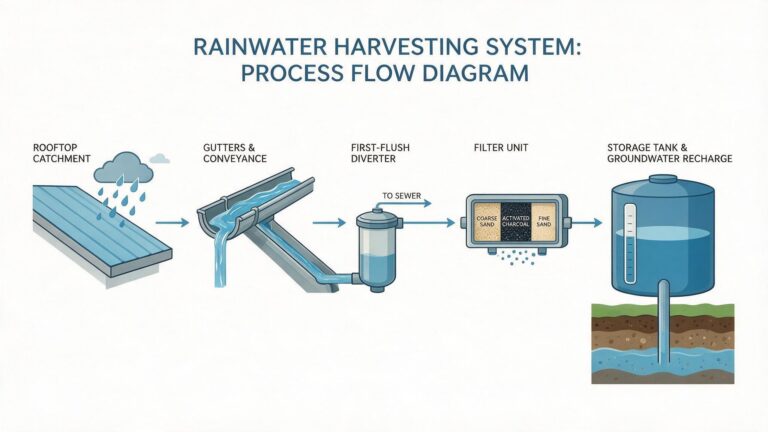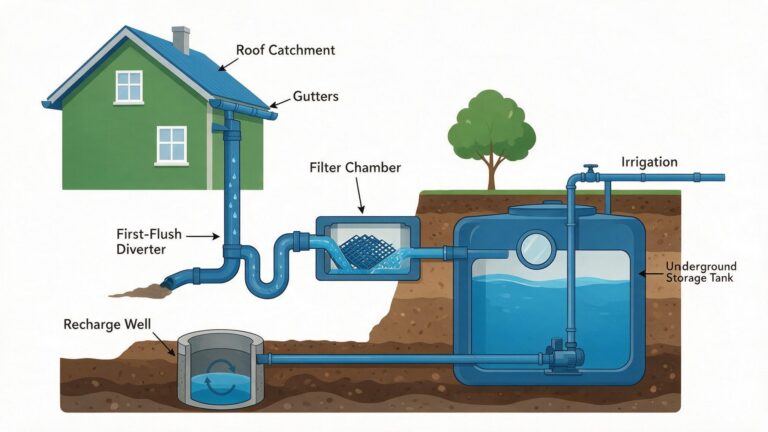
“Purify” gets used loosely to describe anything from a basic sand filter to full drinking-water disinfection, and the right level of purification depends entirely on what the water is going to be used for. Here’s what actually happens at each stage, and which stage is enough for which use.
Stage 1: First-Flush Diversion
Before any filtration begins, a first-flush diverter discards the initial flow of each rainfall — the water carrying the highest concentration of dust, leaf litter, and bird droppings that have settled on the roof since the last rain. This isn’t filtration in the technical sense, but it removes the biggest single source of contamination before it ever reaches a filter, and skipping it puts far more load on every stage that follows.
Stage 2: Sedimentation
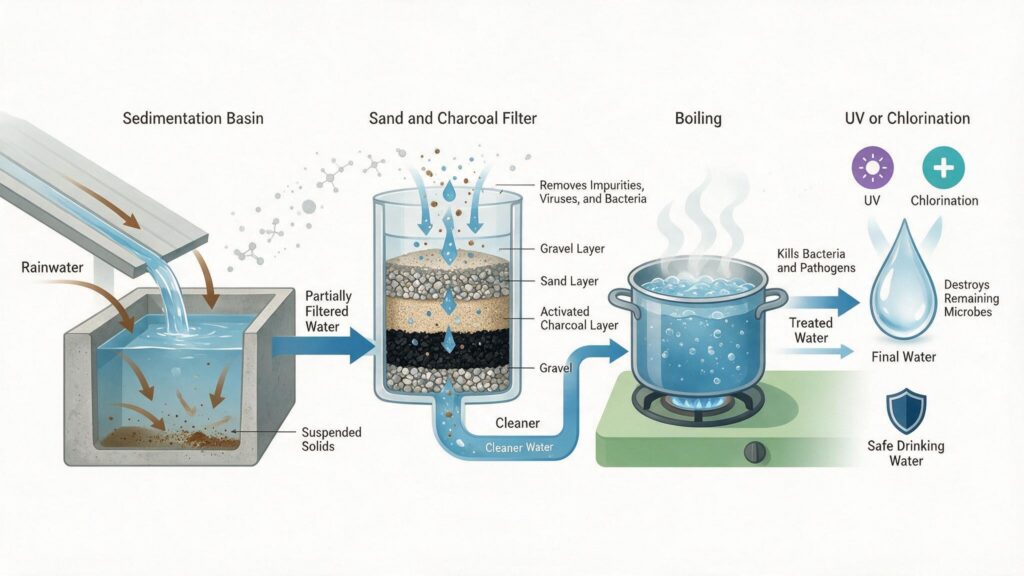
Water is allowed to settle briefly, letting heavier suspended particles sink to the bottom of a collection chamber before the cleaner water above is drawn off. This is a passive step — no mechanical filtration involved — but it meaningfully reduces the particulate load reaching the next stage.
Stage 3: Physical Filtration
This is what most people picture when they hear “filter”: water passes through layers of sand, gravel, and often charcoal, which trap suspended particles and, in the case of charcoal, adsorb some organic compounds and odours. Common designs in Indian systems include layered sand-and-gravel filters, charcoal filters housed in a drum, and proprietary self-cleaning mesh filters. This stage is generally sufficient for non-potable uses — washing, gardening, flushing.
Stage 4: Disinfection
Physical filtration removes particles but doesn’t reliably eliminate bacteria and viruses, which is where disinfection comes in. The common options: UV disinfection, which neutralizes microorganisms with ultraviolet light and adds no chemicals to the water; chlorination, a controlled dose similar to standard municipal treatment; and boiling, effective but impractical as a standing daily-use method. This stage is what separates water that’s simply clean-looking from water that’s actually safe to drink. Our guide on whether you can drink rainwater directly goes into more detail on when this stage is worth adding.
Stage 5: Fine Filtration (Optional)
For the highest standard of treated water, a fine filtration or reverse-osmosis stage after disinfection removes dissolved contaminants that earlier stages don’t address. This level of treatment is uncommon in standard residential systems and is generally reserved for situations where rainwater is the primary or sole drinking-water source.
How Many Stages Does a Typical System Actually Need?
For washing, gardening, and flushing — the majority use case for most Indian residential systems — Stages 1 through 3 are sufficient. Adding Stage 4 (disinfection) is what’s required to make water genuinely drinking-safe, and Stage 5 is reserved for situations where rainwater needs to meet the same standard as treated municipal water on an ongoing basis.
Frequently Asked Questions
Is a charcoal filter enough on its own?
For non-potable use, generally yes when paired with first-flush diversion. Charcoal filtration alone isn’t sufficient for drinking water, since it doesn’t reliably eliminate bacteria and viruses.
How often does a filter need to be cleaned or replaced?
This depends on the filter type and how much debris the catchment area sheds, but most residential filters need cleaning at least before each monsoon season, and sooner if flow noticeably slows.
Can I purify rainwater without any equipment at all?
Boiling is the one purification method that requires no equipment beyond a heat source, and it’s effective against bacteria and viruses, though it doesn’t remove sediment or dissolved contaminants the way filtration does.