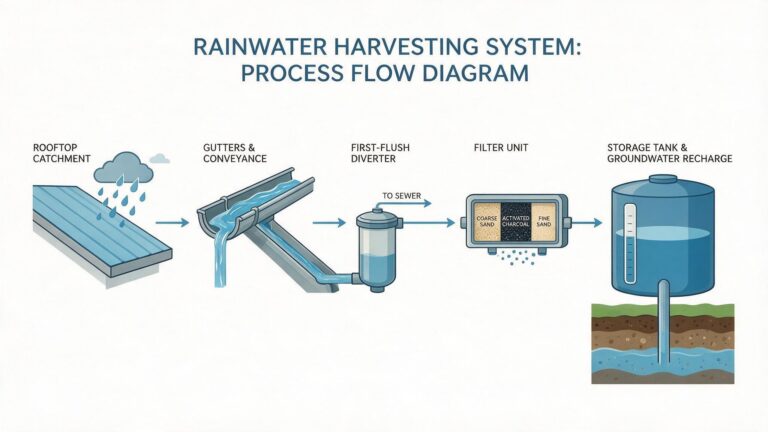
Ask ten people what “rainwater harvesting” means and you’ll get ten different pictures in their head — a barrel under a downspout, a tank on a terrace, a pit dug near a borewell. All of them are right, because rainwater harvesting isn’t one technique. It’s a family of methods, and which one makes sense for a given property depends on the roof area, the soil, the depth to groundwater, and what the water is actually going to be used for.
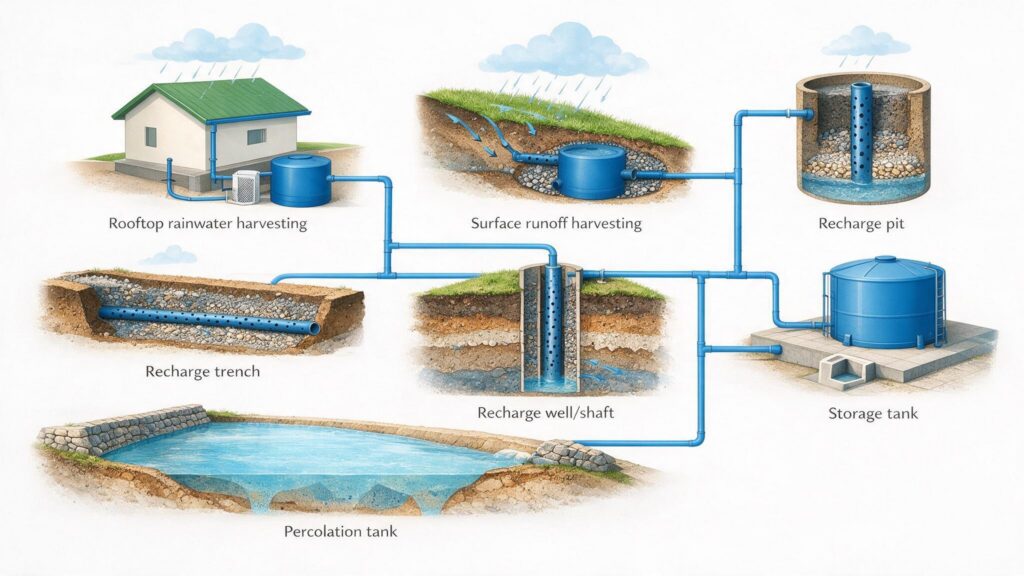
Broadly, every rainwater harvesting system falls into one of two categories: collecting water off a roof or collecting water as it runs across open ground. Within those two categories, engineers and water boards in India generally recognise seven distinct structures, each suited to a different situation. Here’s what each one actually involves.
Quick Facts: Rainwater Harvesting in Brief
- Rainwater harvesting is the practice of collecting and storing rain, either for direct use or to recharge groundwater.
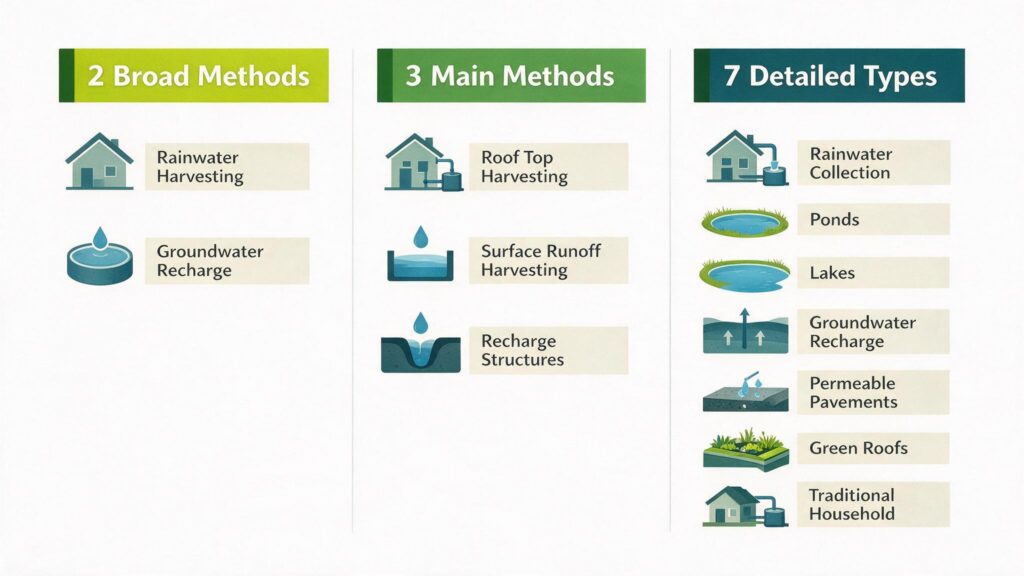
- It splits into two broad approaches — rooftop harvesting and surface runoff harvesting.
- Within those two approaches, there are seven commonly recognised structure types: rooftop harvesting, surface runoff harvesting, recharge pits, recharge trenches, recharge wells, storage tanks, and percolation tanks.
- The right type for a property depends on roof/catchment area, available open space, soil permeability, and depth to the water table.
- Most urban Indian homes use a combination — rooftop catchment feeding a storage tank for use, plus a recharge structure to send the overflow underground.
The Two Broad Approaches First
Before the seven specific types, it helps to understand the two-way split they all sit under:
Rooftop rainwater harvesting uses the roof of a building as the catchment surface. Rain that lands on the roof is channelled through gutters and downpipes into a storage tank or a recharge structure. It’s the most common approach for individual homes and housing societies simply because every building already has a roof — no extra land is needed.
Surface runoff harvesting collects rain after it has already hit the ground — a courtyard, a paved driveway, an open plot, or a road. Because the catchment area is larger and less controlled, this approach usually feeds a bigger structure like a percolation tank or a check dam rather than a storage tank for domestic use.
We cover this split in more detail, including which one fits a given property, in our guide to the two methods of rainwater harvesting.
The 7 Types of Rainwater Harvesting
1. Rooftop Rainwater Harvesting
Water is collected from the roof via gutters and a downpipe, passed through a first-flush diverter (which discards the initial, dirtiest flow of each rainfall) and a filter, then delivered either to a storage tank for reuse or to a recharge structure. This is the backbone of almost every residential system in Nagpur and across Maharashtra, and it’s the structure required under most municipal rainwater harvesting byelaws.
2. Surface Runoff Harvesting
Instead of a roof, the catchment is an open surface — a compound, a parking area, or unpaved ground. Runoff is directed by shallow channels toward a collection point. It’s common on institutional campuses, factories, and larger plots where paved area outside the building is significant enough to be worth capturing on its own.
3. Recharge Pits
A recharge pit is a small excavated pit, typically 1.5 to 3 metres wide and 2 to 3 metres deep, backfilled with layers of boulders, gravel, and coarse sand. Water percolates through the layers and into the surrounding soil, recharging the shallow aquifer directly. Pits are the standard recharge structure for individual homes with modest roof area, because they’re inexpensive to dig and don’t need heavy machinery.
4. Recharge Trenches
Where a plot doesn’t have room for a pit, or the catchment area is spread along a boundary, a recharge trench does the same job in a linear form — typically 0.5 to 1 metre wide and 1 to 1.5 metres deep, filled with brick, pebble, or gravel. Trenches are often used along the perimeter of a compound or beneath a paved driveway, since they don’t take up usable open space the way a pit does.
5. Recharge Wells (Recharge Shafts)
A recharge well is a bored or dug shaft that reaches below the water table, allowing filtered rainwater to be injected directly into a deeper aquifer rather than the shallow soil layer. Because it recharges deeper groundwater, a recharge well needs a higher standard of filtration than a pit or trench — unfiltered water sent straight into a deep aquifer is a genuine contamination risk. This is also the structure most closely tied to CGWA NOC compliance, since it’s the type most commonly inspected when a groundwater extraction application is reviewed.
6. Storage Tanks
Not every system is about recharging groundwater — a storage tank collects rainwater for direct use: washing, gardening, flushing, and in some cases, drinking water after treatment. Tanks can sit above ground, partially underground, or fully underground, and are built from RCC, ferrocement, masonry, or durable plastic. A storage tank is usually paired with a recharge structure so that any overflow, once the tank is full, still goes toward recharging the water table instead of running off into stormwater drains.
7. Percolation Tanks
A percolation tank is a larger, engineered water body — closer to a small reservoir than a domestic structure — built to hold runoff over a wider catchment and let it percolate into the ground gradually over weeks rather than hours. These are typically built by municipal bodies, industrial estates, or large institutional campuses rather than individual households, and they play a bigger role in a region’s overall groundwater balance than any single home’s recharge pit ever could.
Which Type Should You Actually Use?
For most independent homes and housing societies in Nagpur, the practical answer is a combination: rooftop harvesting feeding a storage tank sized to the roof area, with a recharge pit or trench handling the overflow. Which recharge structure fits — pit, trench, or well — comes down to available open space and depth to groundwater, which is exactly the kind of site-specific call worth getting a proper site assessment for rather than guessing. For the full breakdown of what a system actually looks like once these pieces are put together, see our complete guide to rainwater harvesting, and for the step-by-step build process itself, read how the rainwater harvesting process works.
Ready to Choose a System?
Once you know which type fits your property, the next question is often which specific system to actually buy — see our guide on choosing the best rainwater harvesting system in India.
Frequently Asked Questions
Is 7 types the only way to classify rainwater harvesting?
No — you’ll also see rainwater harvesting described as having 2 broad methods (rooftop vs. surface runoff) or 3 main methods (rooftop, surface runoff, and groundwater recharge structures grouped together). These aren’t contradictory; they’re just different levels of detail describing the same set of techniques. We’ve covered all three breakdowns separately: 2 methods and 3 main methods.
Can one property use more than one type at the same time?
Yes, and most well-designed systems do — typically rooftop harvesting feeding both a storage tank and a recharge pit, so the household gets usable water and the excess still recharges groundwater instead of going to waste.
Which type is required by law in Maharashtra?
Municipal byelaws generally require some form of rooftop rainwater harvesting with a recharge structure for buildings above a specified plot size, rather than mandating one specific structure. See our guide on whether rainwater harvesting is mandatory in Nagpur for the exact thresholds.
Do recharge wells need special approval?
Recharge wells that draw on or affect groundwater typically fall within the scope of CGWA oversight. Our guide on the connection between CGWA NOC and rainwater harvesting explains when that applies.