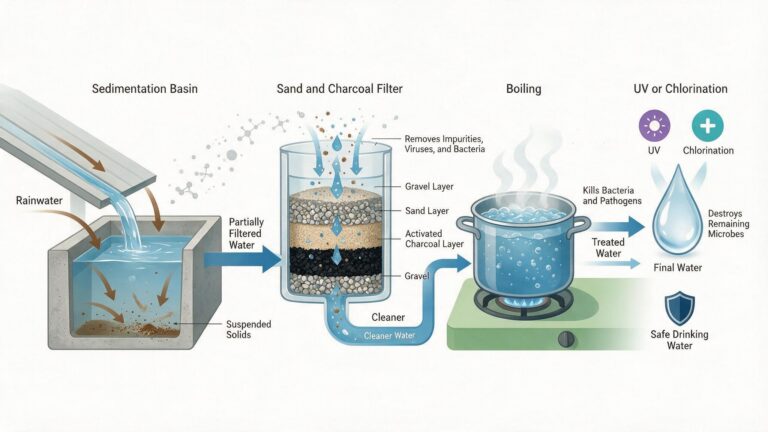
At its simplest, every rainwater harvesting system starts with one question: where is the water being caught? There are only two possible answers — off a roof, or off open ground — and that two-way split is the broadest, most basic classification of rainwater harvesting there is. Everything else, including the seven specific structure types and the three-method purpose-based classification, sits underneath these two.
Method 1: Rooftop Rainwater Harvesting
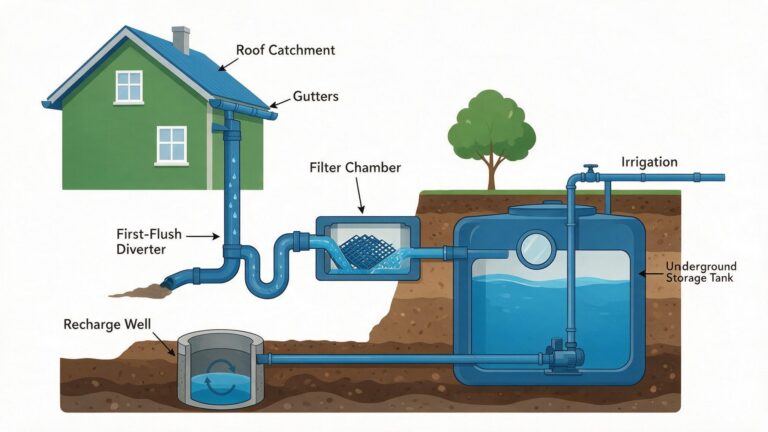
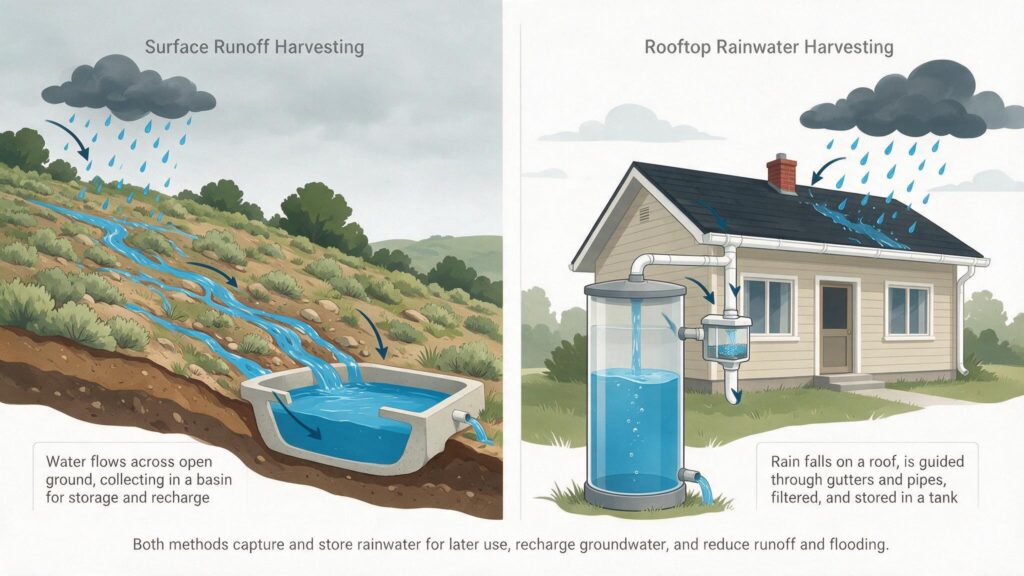
The catchment surface is the roof of a building. Rain lands on the roof, flows to the edge, and is caught by gutters that feed a downpipe, which carries it down to a first-flush diverter, a filter, and finally a storage tank or recharge structure at ground level.
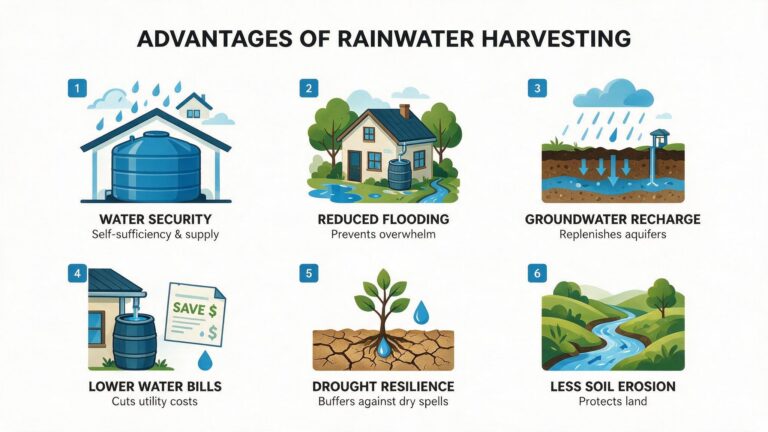
What makes it the default choice: every building already has a roof, so there’s no additional land required. Catchment area is fixed and predictable — you can measure a roof and calculate exactly how much water a given rainfall will produce, which makes system sizing straightforward. It’s also the cleanest catchment surface available on most properties, since a roof collects far less silt and debris than open ground.
Where it falls short: catchment area is capped by the roof’s footprint. A large plot with a small building doesn’t get more water just because the plot is large — rooftop harvesting only sees what actually falls on the built structure.
Method 2: Surface Runoff Harvesting
The catchment surface is open ground — a courtyard, a compound, an unpaved plot, a road, or any area where rain hits the ground directly rather than a roof. Shallow channels or drains direct the runoff toward a collection point, which is usually a larger structure such as a percolation tank rather than a household storage tank.
What makes it worth using: on a large plot, the open ground can represent a far bigger catchment area than the building’s roof. Institutional campuses, factories, and large housing layouts with significant common open space are the properties where this method earns its place alongside rooftop harvesting rather than instead of it.
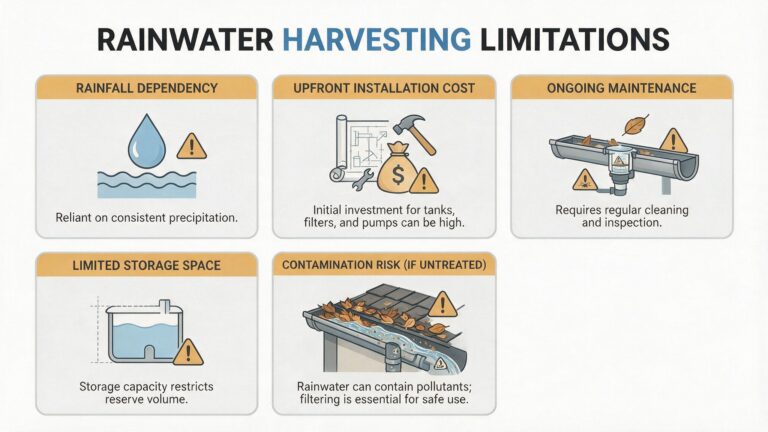
Where it falls short: runoff from open ground carries more silt, debris, and surface contaminants than roof runoff, which means it typically needs more substantial filtration or settling before it’s usable, and it’s harder to predict yield precisely since ground absorption varies with soil condition and how recently it rained.
Rooftop vs. Surface Runoff: Which Fits Your Property?
For the overwhelming majority of individual homes and housing societies, rooftop harvesting is the method that actually gets built — it’s simpler to design, cheaper to filter, and it’s what most municipal byelaws, including Nagpur’s, are written around. Surface runoff harvesting becomes worth adding when a property has substantial open catchment beyond the building itself: a factory yard, an institutional campus, or a housing layout with large common areas. On most residential plots, the open ground around a house is landscaping or parking, not a meaningful catchment surface, so rooftop harvesting alone covers the practical need.
If you’re past the “which broad method” question and want the specific structures — recharge pit vs. trench vs. well — that’s covered in our guide to the seven types of rainwater harvesting.
Starting Smaller
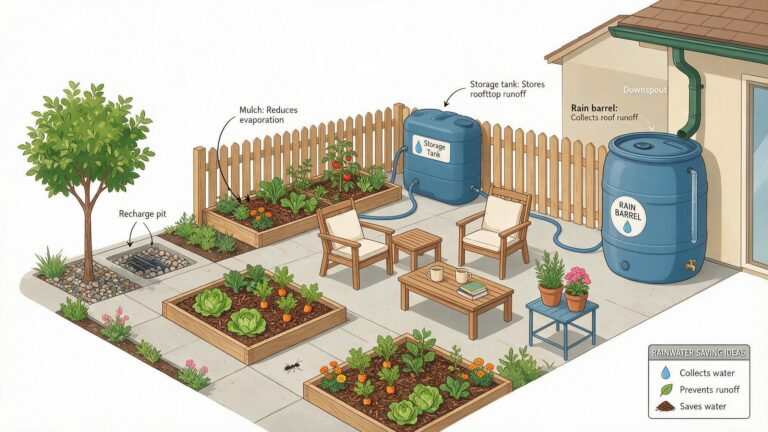
If you’re looking for smaller-scale starting points rather than a full system, see our guide to 10 ways to save rainwater at home.
Frequently Asked Questions
Can a property use both methods at once?
Yes, and larger properties often do — rooftop catchment from the buildings plus surface runoff harvesting from open compound area, both feeding into the same recharge or storage infrastructure.
Is one method more efficient than the other?
Rooftop harvesting is more water-efficient per square metre of catchment, since a hard roof loses less water to absorption than open ground does. Surface runoff harvesting can still capture more total volume simply because the catchment area available is often larger, even though a bigger share of that rainfall never makes it to the collection point.
Does surface runoff harvesting need different filtration than rooftop harvesting?
Generally yes. Ground-level runoff picks up more silt and organic debris than roof runoff, so systems built around it typically include a settling or desilting stage before the water reaches a filter, on top of the usual first-flush and filtration steps.