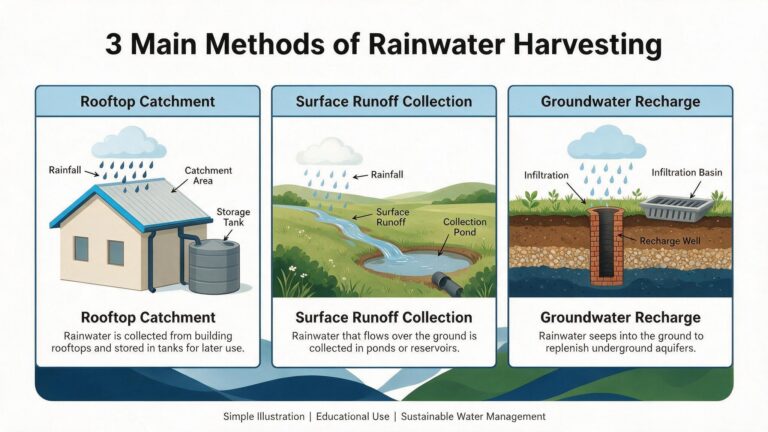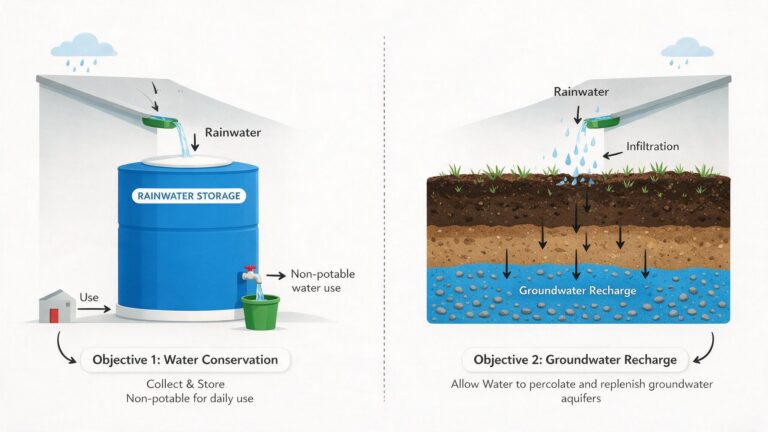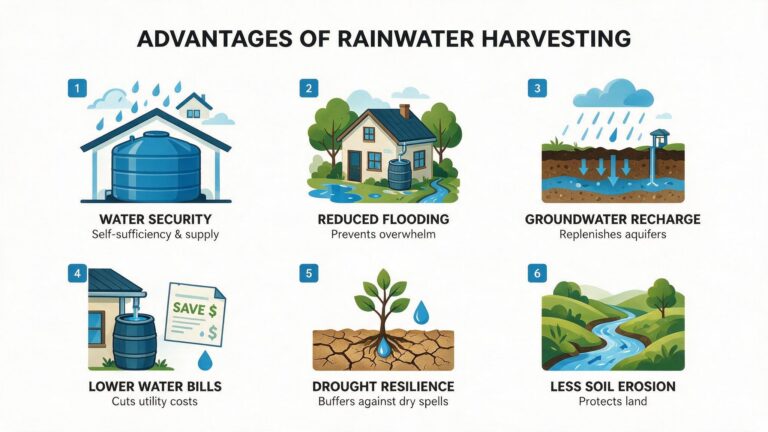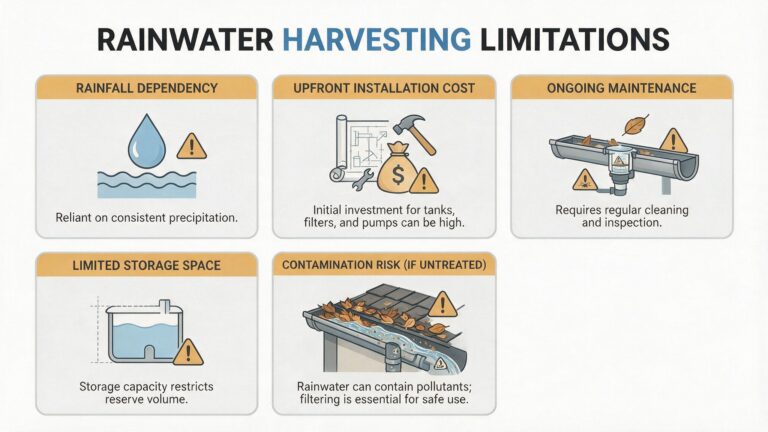
Modern rainwater harvesting in India isn’t actually modern. Long before recharge pits and first-flush diverters had names, communities across the country were building structures to catch and store monsoon rain for the dry months ahead — and some of these traditional systems were sophisticated enough that engineers still study them today. Here are three of the best-documented traditional methods, each from a different part of the country, and what made each one work.
1. Johad (Rajasthan)
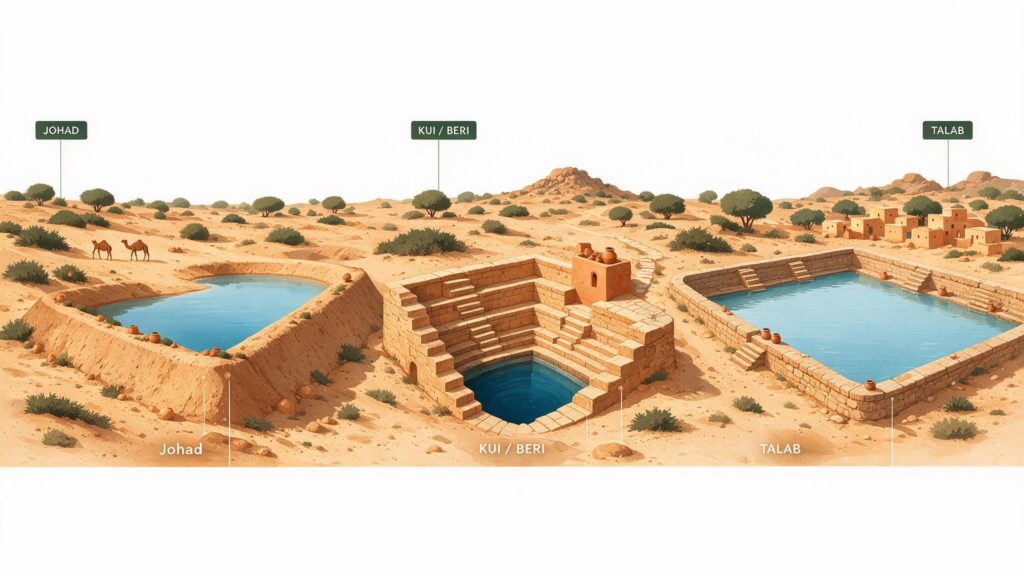
A johad is a small, crescent-shaped earthen check dam built across the natural slope of a catchment area, designed to capture and hold monsoon runoff long enough for it to soak into the ground rather than flow away. They’re built low and wide rather than tall, spread across a watershed in a series rather than as one large structure, so rainfall gets captured close to where it falls.
The best-documented example of johads at scale is in Alwar district, Rajasthan, where community-led revival of roughly 3,000 johads was credited with raising local groundwater levels by around 6 metres — a striking result for a structure that requires no cement, no pumps, and relatively simple earthwork to build and maintain.
2. The Paar System (Western Rajasthan)
In the arid stretches of western Rajasthan, particularly around Jaisalmer, rainfall is too scarce and too infrequent for surface storage alone to be reliable. The paar system works around that by using a catchment area, called an agar, where rainwater is allowed to flow and percolate into sandy soil rather than pool on the surface. The water is then accessed through shallow wells — known locally as kuis or beris, typically 5 to 12 metres deep — dug into the same sandy aquifer the agar recharges. Some paar systems in the Jaisalmer region operate with more than 20 kuis drawing from a single shared catchment, functioning as a distributed groundwater storage network rather than one central tank.
3. Talab and Bandhis (Multiple Regions)
Talabs and bandhis are reservoirs — sometimes natural ponds shaped and deepened by hand, sometimes fully human-made lakes — built to hold monsoon runoff for irrigation and drinking water through the dry season. Unlike a johad, which is built primarily to recharge groundwater, a talab is a visible surface store: villages historically drew directly from it, and once the water receded after the monsoon, the exposed lakebed was often cultivated with rice before the cycle repeated the following year. Versions of this structure appear across several regions of India under different local names, reflecting how widely the basic idea — store the monsoon, use it through the dry months — was independently arrived at across the country.
Why These Still Matter for Modern Design
Traditional systems like these share a principle that modern rainwater harvesting design still relies on: capture water close to where it falls, rather than trying to move it long distances after the fact. A johad’s distributed, close-to-source design and a paar system’s use of local soil permeability are the same logic behind why a modern recharge pit gets placed near the point of runoff rather than at the far end of a property. The materials and scale have changed — concrete and PVC instead of packed earth — but the underlying design principle is the same one behind the rainwater harvesting process we use today.
For the structures actually used in urban and residential systems now, see our guide to the seven types of rainwater harvesting.
Frequently Asked Questions
Are traditional methods like johads still built today?
Yes, particularly in rural water-conservation and watershed-restoration projects, where community-led johad construction and revival remains an active practice in parts of Rajasthan and neighbouring states.
Why did India develop so many different traditional water harvesting structures?
Rainfall patterns, soil type, and terrain vary enormously across India, and each traditional structure evolved to fit local conditions — a design that works for the sandy, low-rainfall terrain of western Rajasthan wouldn’t necessarily suit a higher-rainfall region with different soil.
Do these traditional methods have any role in a modern residential system?
Not directly as structures — a homeowner isn’t digging a johad in Nagpur — but the underlying design principle, capturing water near where it falls rather than after it has already run off, still shapes how a modern recharge pit or trench is sited on a property.